

Ripple-65B Preview costs $0.20 per million input tokens and $0.60 per million output tokens on OpenRouter as of 5 November 2026. That makes a 30,000-input, 2,000-output coding-agent step cost $7.20 per 1,000 runs, while Ricursive’s 65B open-weight model advertises a 1,048,576-token context window.
At a glance
- Ripple-65B Preview is a 65B dense model released on 4 November 2026 under Apache 2.0.
- OpenRouter lists Ripple at $0.20 input and $0.60 output per million tokens.
- Ricursive reports 80.52 on TerminalBench 2.1, versus Reflection Beam’s reported 80.1.
- Our standard agent-step calculation puts Ripple at $7.20 per 1,000 requests.
- OpenAI gpt-oss-120b costs $0.52 per 1,000 equivalent agent steps, but has a 131K-token context limit.
What is Ripple-65B Preview?
Ripple-65B Preview is Ricursive Intelligence’s downloadable instruction model, not the XRP payments company or its cryptocurrency. Its model card identifies it as a 65B-parameter dense Transformer, meaning every parameter participates when it generates a token.
Ricursive says the model was pretrained on 12 trillion tokens and supports up to 1M tokens of context. Tokens are the chunks of text a model reads and bills by. A million-token limit can hold a large repository, logs and tool output in one request, but it does not prove the model will reason reliably across all of that material.
The weights use Apache 2.0, a permissive licence that permits commercial use and modification. Ricursive also offers BF16 and NVFP4 variants. BF16 preserves higher numerical precision, while NVFP4 reduces weight storage for more practical local serving.
How strong is Ripple on coding benchmarks?
Ricursive reports a TerminalBench 2.1 score of 80.52 for Ripple-65B Preview. Its comparison table places Reflection Beam at 80.1, Meta Muse Spark Open at 76.4, and NVIDIA Nemotron 3 Ultra at 56.4.
That is a narrow lead over Beam, not a general coding crown. Reflection’s final Beam model card reports 80.1% on Terminal Bench v2.1, but it reports stronger results than Ripple on several other software-engineering tests, including SWE-bench Verified and SciCode.
| Model | TerminalBench 2.1 | DeepSWE 1.1 | What the figure can support | Evidence tier |
|---|---|---|---|---|
| Ripple-65B Preview | 80.5 | 44.3 | Strong terminal-task claim, but weaker long-horizon engineering score than some rivals. | B: vendor-reported |
| Reflection Beam | 80.1 | 43.3 | Near-tie on TerminalBench, based on Reflection’s own model-card configuration. | B: vendor-reported |
| Muse Spark Open | 76.4 | 60.0 | Ripple’s own table shows Muse ahead on DeepSWE despite trailing on TerminalBench. | B: vendor-compiled comparison |
The scores above come from model makers’ published tables. They are useful screening signals, not independent procurement tests. Harnesses, prompts, tool permissions, token budgets and benchmark revisions can change results.
How much does a coding agent cost?
Ripple is cheap for an API model with a listed 1M-token window, but it is not the cheapest open-weight endpoint. OpenAI gpt-oss-120b is listed at $0.014 input and $0.05 output per million tokens, against Ripple’s $0.20 and $0.60 rates.
Our calculations use three fixed workloads: a chat turn has 1,000 input and 500 output tokens; a retrieval-augmented generation, or RAG, answer has 8,000 input and 500 output tokens; and an agent step has 30,000 input and 2,000 output tokens. They exclude cache charges, web-search fees, hosting, retries and tool costs.
| Concrete option | Context limit | Chat turns | RAG answers | Agent steps | Best fit | Evidence tier |
|---|---|---|---|---|---|---|
| Ripple-65B Preview | 1,048,576 tokens | $0.50 | $1.90 | $7.20 | Long repository work and open-weight deployment experiments. | A: live marketplace price |
| OpenAI gpt-oss-120b | 131,072 tokens | $0.04 | $0.14 | $0.52 | Low-cost work that fits inside a 131K-token request. | A: live marketplace price |
| Google Gemini 3 Flash Preview | 1,048,576 tokens | $2.00 | $5.50 | $21.00 | Teams that need a hosted multimodal model and accept higher token bills. | A: live marketplace price |
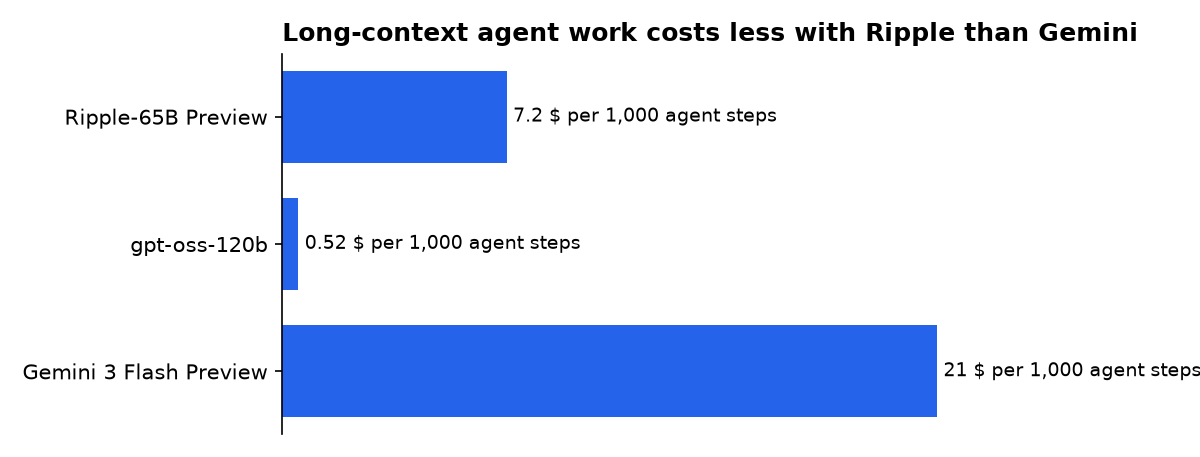
Gemini 3 Flash Preview lists $0.50 input and $3.00 output per million tokens, so it costs almost three times Ripple on the defined agent workload. The calculation reflects billing, not quality. Gemini may still be the better choice where its multimodal inputs, provider support or evaluation results matter more than the token rate.
Is the 1M-token context usable today?
OpenRouter currently lists a 1.0M context limit for Ripple-65B Preview. The same listing shows one GMICloud provider at 153 tokens per second, which is a marketplace measurement rather than Ricursive’s own hardware claim.
Context length is a ceiling, not a promise that every million-token prompt will be affordable or accurate. A 1M-token input alone costs $0.20 at the listed input rate. Re-reading that full prompt repeatedly can dominate an agent’s bill, even before it writes code or calls tools.
Ripple’s architecture helps explain the design goal. Research on hybrid attention finds that combining local and global attention can improve long-context efficiency. Ricursive says Ripple uses global NoPE and a larger mix of sliding-window attention layers, but it has not published an independent million-token retrieval evaluation for this release.
What do the architecture claims mean?
Ricursive describes Ripple as thin and deep, with 80 layers and a 5,120-wide model dimension. The company says it added gated attention, global NoPE, value residuals and activation clipping to improve training and agentic reasoning.
Gated attention means the model learns how strongly to pass through each attention result. A 2025 study found that a head-specific gate improved stability and long-context extrapolation in its experiments. That supports the technique’s plausibility, but it does not verify Ripple’s claimed benchmark gains.
Ricursive’s local-hardware argument also needs care. The company says Ripple can fit on an NVIDIA DGX Spark through its NVFP4 checkpoint, while its BF16 weights are much larger. Buyers should treat “fits” and “serves a million-token coding agent at useful speed” as different questions.
How does Ripple compare with Beam?
Ripple is dramatically smaller by total parameter count than Reflection Beam. Reflection describes Beam as a 501B-parameter mixture-of-experts model with 23B active parameters, while Ripple is a 65B dense model with all 65B active per token.
That distinction matters for self-hosting. A mixture-of-experts model stores many parameters but activates only a subset on each token. Ripple’s dense design is simpler to describe, but its 65B parameters remain active every time it generates text.
Ricursive claims it trained Ripple for $32M, including research and development rather than only the final training run. The company also claims that figure is one-tenth the cost of the prior U.S. open-weight agentic-coding leader. No independently audited training-cost breakdown is public, so buyers should not use that figure as a direct operating-cost forecast.
Which option should you buy?
Choose Ripple-65B Preview if you need an open-weight coding model, want a listed 1M-token API window, and can validate it on your own repositories. The $7.20-per-1,000-agent-step estimate makes it a credible trial option for long-context tasks.
- Pick gpt-oss-120b when requests fit within 131K tokens and unit cost is the first constraint.
- Pick Ripple-65B Preview when you need open weights and may use very large repository contexts.
- Pick Gemini 3 Flash Preview when hosted multimodal features outweigh a higher bill.
- Do not buy on TerminalBench alone. Run a fixed set of your bugs, code reviews and tool workflows first.
What we could not verify?
Ricursive has not published an independent third-party evaluation of Ripple-65B Preview, including a controlled test at a full 1M-token prompt. Public material also does not establish the hardware cost, latency or quality of a self-hosted million-token deployment.
The model’s $0.20 and $0.60 rates are marketplace prices, not a Ricursive-owned price schedule. Ricursive, inference hosts and independent evaluators could settle those questions by publishing stable endpoint limits, reproducible harness settings and external long-context tests.
Sources
- OpenRouter: Ripple-65B Preview pricing and context
- OpenRouter: gpt-oss-120b pricing and context
- Ricursive Intelligence model card on Hugging Face
- Ricursive Intelligence Ripple launch page
- Reflection Beam model card
- Reflection Beam launch post
- Rope to Nope and Back Again: A New Hybrid Attention Strategy
- Gated Attention for Large Language Models

