
As of 21 November 2026, Lightricks LTX-2.3 is the clearest documented choice for fine-tuning proprietary product footage and self-hosting the result. Wan2.2 is the strongest permissively licensed local alternative with public weights, but “Wan 2.7” cannot yet be verified as an open-weight, self-hostable training stack. Neither model makes a deployment automatically GDPR-compliant.
At a glance
- LTX-2.3 has official LoRA training instructions, with about 32 GB of GPU memory suggested for its low-VRAM configuration.
- LTX-2.3 full fine-tuning typically needs 4 to 8 H100 GPUs with 80 GB each, according to Lightricks’ training guide.
- Wan2.2 publishes local text-to-video and image-to-video weights for 480p and 720p generation, including a 5B model listed at 24 frames per second.
- LTX-2 derivatives remain under the LTX-2 Community License, and organisations with annual revenue of at least $10 million need a paid commercial licence.
- Self-hosting can reduce transfers to a model vendor, but GDPR still requires a lawful purpose, data minimisation and appropriate safeguards.
Which models suit private product-footage tuning?
For a company that wants generated product shots to resemble its own packaging, hardware or software interface, the shortlist is short. Lightricks LTX-2.3 is the best documented option because its publisher ships both a trainer and explicit modes for LoRA, a small add-on that changes selected model weights, and full fine-tuning.
Wan2.2 is the other serious choice for teams that need a permissive software licence. Its official model card offers local downloads for a text-to-video A14B model, an image-to-video A14B model and a smaller TI2V-5B model. It supports 480p and 720p paths, while the 5B listing specifies 720p at 24 frames per second. (huggingface.co)
The important distinction is between self-hostable inference and fine-tuning. You can run a model in your own environment without ever changing its learned behaviour. Fine-tuning is a separate training job using your clips, captions and validation material. It produces a new adapter or new weights that also need access control, retention rules and security review.
What was promised versus what shipped?
The open-video market has moved from local inference demos toward trainable model stacks. The dated record matters because a model name alone does not tell a compliance team whether it can actually be adapted and operated without a hosted API.
- 27 January 2025
Hugging Face’s Diffusers team described LTX-Video, CogVideoX, HunyuanVideo and Mochi as open video models, while warning that memory needs made local generation difficult. Its specified earlier LTX-Video workflow used 17.75 GB of memory on an 80 GB A100. That was a benchmark configuration, not a promise that later LTX releases fit on a laptop. (huggingface.co)
- 28 July 2025
Wan’s official model card records the release of Wan2.2 inference code and weights. What shipped was a local-generation package, including the A14B text-to-video model and 5B text-and-image-to-video model. The card does not itself provide an official proprietary-footage fine-tuning workflow. (huggingface.co)
- 5 January 2026
The LTX-2 Community License took effect for LTX-2 releases, including LTX-2.3. It expressly treats fine-tuned and adapted weights as derivatives, so a company cannot assume that an internally trained adapter has escaped the base model’s terms. (huggingface.co)
- 19 October 2026
FuturPulse’s earlier local-stack analysis found that LTX-2.5 had become the newer generated-footage option, while LTX-2.3 remained the lower-memory route for iteration. That does not replace LTX-2.3’s training case: a newer generation model is not automatically the easier model to adapt or govern. (huggingface.co)
- 21 November 2026
Lightricks’ current LTX trainer documentation provides LoRA and full-transformer modes for its model family. This is the material difference for proprietary footage: the vendor publishes a route to train, checkpoint and run a custom result in infrastructure you control. (github.com)
Can proprietary footage be used for fine-tuning?
Yes, if the company has the rights to use the footage for training and builds a controlled training pipeline. Lightricks’ LTX trainer preprocesses media once into latents, compact numerical representations of video and audio, then trains from those cached files. The same guide says preprocessing also encodes captions into text embeddings. (github.com)
That means the sensitive-data surface is broader than the original MP4 files. A project may hold source clips, captions, latent caches, checkpoint files, validation videos, training logs and exported adapters. Treat each as potentially sensitive if the footage includes identifiable people, customer locations, unreleased products, serial numbers or screens containing account data.
For product footage, start with LoRA rather than full fine-tuning. LoRA trains an adapter instead of rewriting the entire base model. It is usually easier to version, test and remove. It also gives the team a clear question to answer: does the adapter teach the desired product appearance and camera language without reproducing confidential scenes
- Use clips that your organisation owns or has a documented licence to train on.
- Remove customer names, faces, addresses, device identifiers and internal dashboards where possible.
- Caption clips with the intended product attributes, not confidential launch details.
- Keep a small holdout set for testing rather than using every clip for training.
- Test prompts designed to reveal memorisation before publishing the adapter internally.
How much infrastructure does LTX-2.3 training need?
LTX-2.3 can be adapted on a serious workstation, but full tuning is a data-centre task. Lightricks recommends 80 GB of GPU memory for its standard trainer configuration. Its low-VRAM configuration is aimed at GPUs with roughly 32 GB, using INT8 quantisation and memory-saving techniques. (github.com)
Full fine-tuning changes all transformer parameters rather than attaching a LoRA. Lightricks says that path typically needs 4 to 8 H100 GPUs, each with 80 GB of memory. That makes full tuning an enterprise project with a cost and security profile closer to a private compute cluster than to a marketing-team workstation. (github.com)
| Adaptation route | Published memory figure | What changes | Best fit for proprietary footage |
|---|---|---|---|
| LTX-2.3 low-VRAM LoRA | About 32 GB GPU memory | A small adapter | Product look, branded objects and repeatable visual style |
| LTX-2.3 standard LoRA | 80 GB GPU memory recommended | A small adapter | Higher-throughput experimentation and validation |
| LTX-2.3 full fine-tune | 80 GB per GPU | All transformer parameters | Only when LoRA cannot meet a tested requirement |
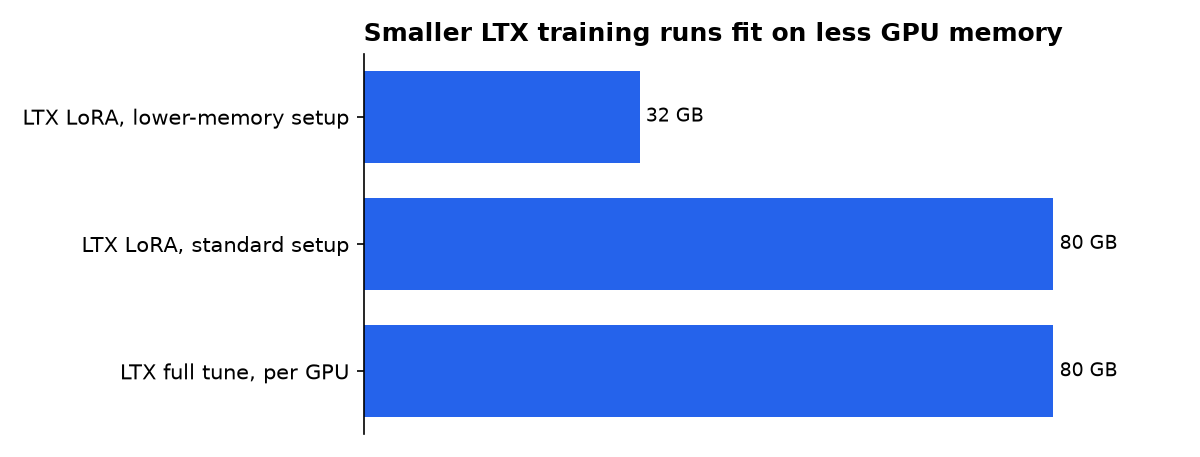
The comparison is not a performance ranking. It is an operational decision. A 32 GB LoRA route is more plausible for a private test environment. The full-tune figure excludes the fact that Lightricks expects several GPUs, which multiplies procurement, scheduling and access-control work.
What does self-hosting change for GDPR?
Self-hosting can keep source footage, embeddings and output files in infrastructure selected by the organisation. It does not remove GDPR duties. Article 5 of the GDPR requires personal data to be processed lawfully, for specified purposes and in a form limited to what is necessary. (eur-lex.europa.eu)
For a product-video team, the practical result is simple: “we run the model locally” is not a compliance conclusion. The company still needs a lawful basis where footage includes personal data, a purpose statement for training, retention limits, user permissions, security controls and a process for responding to data-subject rights.
Use an internal or EU-region deployment if data sovereignty requires it, but map every connection first. A supposedly local workflow can still send prompts to a hosted captioning model, metrics to an experiment-tracking service, voiceover text to a speech API, or model downloads through a third-party hub. Disable or contract for those transfers before production use.
Which licence boundaries matter most?
LTX-2.3 is not Apache-2.0 software. The LTX-2 Community License grants rights to use, reproduce, modify and create derivatives, subject to its restrictions. It says entities with annual revenue of at least $10 million need a paid commercial-use licence for LTX-2 and its derivatives. (huggingface.co)
That threshold matters even when every server is inside your own network. Self-hosting answers where processing occurs. The model licence answers whether your organisation may use the base weights and the adapted result for the intended commercial activity. Legal review should cover both before a training run begins.
Wan2.2 is more attractive where permissive licensing is decisive. Its official project is distributed under Apache-2.0, and its public card describes local model downloads and inference. However, the training stack, third-party adapters and any hosted tooling used around the model can introduce separate licences and terms. (huggingface.co)
Is LTX 2.3 free and open-source?
LTX-2.3 is publicly available with code, weights and fine-tuning tools, but “free and open-source” needs a qualification. The LTX-2 Community License allows use and derivatives under stated conditions, including rules for derivative weights. It is not the same as an unrestricted permissive licence such as Apache-2.0. (huggingface.co)
For organisations below the licence’s $10 million annual-revenue threshold, the published terms provide a royalty-free route subject to the agreement and use restrictions. Organisations at or above that threshold need a commercial-use agreement from Lightricks. The licence date is 5 January 2026, so teams should preserve the exact terms reviewed for their release and adapter. (huggingface.co)
The hosted LTX Studio product is a separate offering. Its free plan is listed at $0 and labels its access as a personal-use licence, which is not a substitute for assessing the LTX-2 model licence for an internal commercial product-footage workflow. (website.ltx.studio)
What deployment pattern is safest?
The safest practical pattern is a segregated training environment. Put raw footage in a restricted store, run preprocessing and LoRA training in the same controlled network, encrypt backups, and limit the output adapter to the team that needs it. Keep an inventory tying each adapter to its base model, training dataset version, licence review and validation report.
Separate experimentation from production. In experimentation, use sanitised clips and short retention windows. In production, use approved footage only, log model and adapter versions, and have a human review outputs before public release. Generated footage can still expose a confidential prototype through memorisation or an over-specific prompt.
Do not confuse a local renderer with a local generative model. For example, huashu-motion states that it builds launch films as editable browser-rendered code and does not generate live-action footage from a video model. That can be a better privacy choice for animated UI demos, but it will not learn the visual behaviour of a physical product from training clips. (huggingface.co)
What we could not verify?
No public evidence reviewed here confirms that a model called Wan 2.7 has released open weights, an official fine-tuning workflow and terms that permit the proposed self-hosted commercial use. Wan’s publisher could settle that with an official model card, code repository and licence.
No model publisher can certify a customer’s GDPR compliance from the model licence alone. The controller, its data protection officer or relevant supervisory authority would need to assess the footage, purposes, locations, suppliers, retention rules and safeguards. The critical next step is a data-flow review before any proprietary footage reaches a training job.
Sources
- Lightricks LTX-2 Trainer quick-start guide
- Lightricks LTX-2 training modes
- Wan2.2 official model card
- Hugging Face Diffusers: State of open video generation models
- General Data Protection Regulation, Article 5
- LTX Studio pricing and personal-use terms
- FuturPulse: Open-source AI video generators local-stack analysis

