
FuturPulse analysis · 24 November 2026
Safe Anything is a Rust command-line scanner with 74 documented rules for code, secrets, configuration, mobile files, dependencies and AI-agent setup files. It can identify risky patterns in a GitHub repository, but it cannot prove the repository is safe because it does not follow data through a running program.
At a glance
- Safe Anything currently groups its checks into six families, from code patterns to locked dependency versions.
- The published rule list contains 24 code rules and 16 secret rules.
- The project says it skips files over 2 MB, generated folders and several file types, which creates deliberate blind spots.
- A 22 November 2026 status report says the GitHub Action has not yet been run and its SARIF output has not yet been uploaded to GitHub code scanning.
What does Safe Anything scan in a repository?
Safe Anything scans source files and repository configuration for recognizable security signals. Its main repository describes coverage for SQL injection, command injection, cross-site scripting, or XSS, secrets, cloud settings, dependency advisories and agent instructions. XSS means hostile script runs in another person’s browser through a web page.
The scanner’s value is breadth in a single local command. It examines ordinary application code alongside Dockerfiles, GitHub Actions workflows, Terraform, Kubernetes, Android and iOS settings, plus files that configure coding agents. That makes it useful for a pull request where security problems may sit outside the application’s main language.
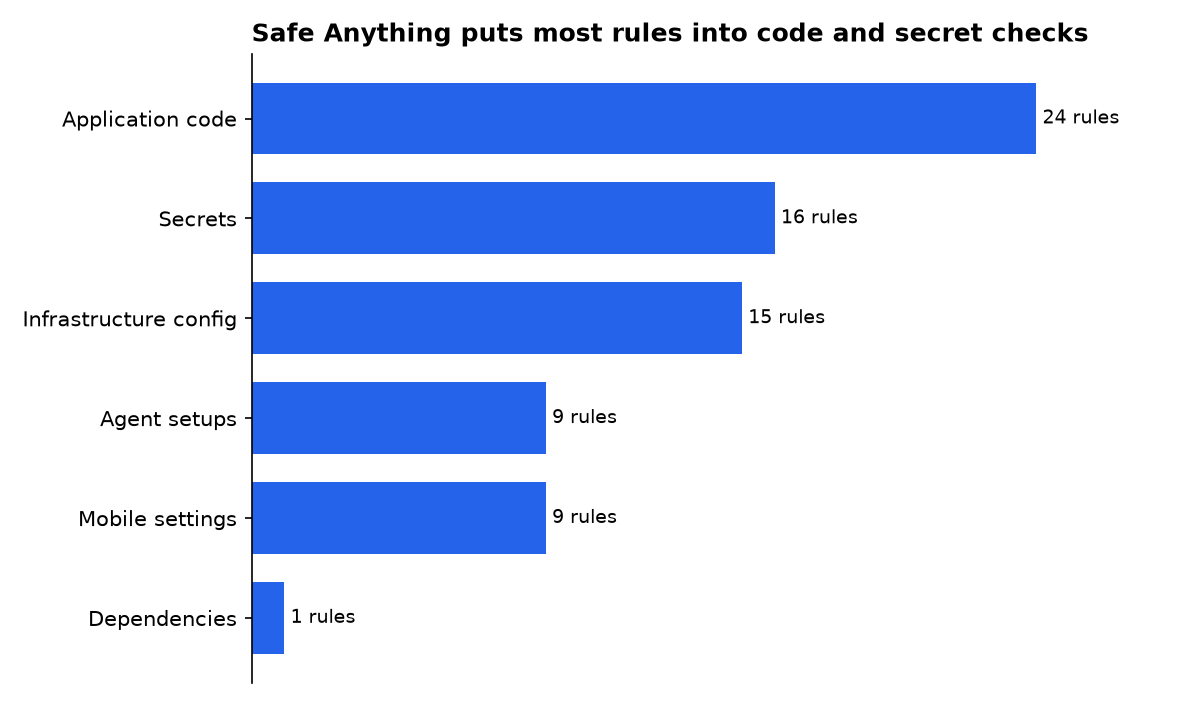
Its published rule list divides that breadth into code, secrets, agent setups, mobile, configuration and dependencies. The counts below describe the current rules, not an independently measured detection rate. The project’s generated rule inventory lists 74 rules in total.
| Repository area | Rules | What Safe Anything looks for | What that means in review |
|---|---|---|---|
| Application code | 24 | Injection, unsafe deserialization, weak cryptography and insecure cookies | Fast prompts for a reviewer to inspect risky constructs |
| Secrets | 16 | Provider keys, private keys, passwords and exposed environment values | Useful before a credential reaches a public branch |
| Agent setups | 9 | Unrestricted permissions, remote scripts and unsafe MCP settings | Checks the instructions and tools given to an AI agent |
| Mobile settings | 9 | Android, iOS, WebView and insecure-storage settings | Flags common mobile configuration exposures |
| Infrastructure config | 15 | Docker, GitHub Actions, Kubernetes, Terraform and nginx risks | Brings deployment files into the same review pass |
| Dependencies | 1 | A locked package version with a known published advisory | Finds known vulnerable versions, not unknown malicious behavior |
What was promised, and what has shipped?
Safe Anything’s public position is clear: it promises one scanner across several repository surfaces. The more useful question is which parts have been exercised against real code and which are still fixture-tested. The project’s own dated status page draws that line.
8 September 2023 — dependency-update research defined a narrower problem. The research behind DepSafe studied unsafe dependency updates across a population of 88,416 pull requests. Its scope was dependency-update risk, not a whole-repository security audit. The paper is useful context because Safe Anything’s dependency check is only one rule family among many.
22 November 2026 — Safe Anything recorded its validation status. The project marked code, secrets, agent setup, configuration and dependency families as verified in named runs or live advisory checks. Mobile checks were listed as tested on fixtures only. The status report also records known limits, rather than presenting a clean result as a guarantee.
24 November 2026 — the public repository lists 74 rules. The scanner’s repository describes a Rust-based tool that reports a line, reason and suggested fix for findings. Its current README is explicit that a scan is designed to find selected classes of problems across code and configuration. The repository does not claim formal verification or complete vulnerability discovery.
How does the Rust scanner make decisions?
Safe Anything uses pattern matching. In plain English, it looks for code or configuration that resembles a known dangerous shape, such as a SQL query built by string formatting or a GitHub Actions workflow that grants broad write permission. That approach is quick and explainable because a result can point to a specific line.
The rule inventory shows this clearly. It marks calls such as eval, string-built shell commands, string-built SQL, user-controlled URLs fetched by a server, and several unsafe deserialization APIs. OWASP’s injection guidance recommends safer APIs, input validation and contextual escaping, but whether a given line is exploitable often depends on surrounding code.
That distinction matters. A scanner can notice that HTML flows into innerHTML, but it may not know whether the value is trusted, escaped or unreachable by an attacker. The project itself calls its noisiest rule code.xss-inner-html, because legitimate local tooling can resemble a real browser-facing XSS flaw.
Which AI-agent risks can it flag?
Safe Anything’s agent rules inspect local instructions, hooks, skills and Model Context Protocol, or MCP, configuration. MCP is a way for an AI agent to call tools and services. The scanner flags broad permission bypasses, pre-approved shell use, plain-text tool tokens, unpinned tool launches, remote HTTP servers and instructions that read credential files.
It also looks for prompt-injection language and invisible Unicode characters in agent instructions. These are sensible warning signs, but not a full defence against a malicious document or website. OWASP’s prompt-injection guidance says harmful instructions can be invisible to a person yet still parsed by a model, and it says fool-proof prevention remains unclear.
That is the scanner’s sharpest limit in the agent category. It can identify text that resembles “ignore previous instructions,” a hook that pipes a download into a shell, or an MCP server without a fixed version. It cannot establish whether a model will obey a hostile instruction, whether a tool call has proper runtime approval, or what data a connected service will return later.
What does Safe Anything deliberately skip?
Safe Anything avoids many paths and files to keep scans practical. Its README says it respects .gitignore, skips common dependency and build folders, ignores binary files, and does not run ordinary code rules against lockfiles. It also skips files larger than 2 MB, including a lockfile that large.
Those choices reduce noise and prevent a scan from spending time on generated output. They also mean a dangerous artifact in build/, dist/, a vendor directory or an oversized file is outside its normal review. A repository owner should decide whether those folders are reproducible output or code that needs separate scanning.
Tests, specifications and fixtures get special handling too. The scanner normally limits findings in those files to real provider keys and private keys, unless the user enables --include-tests. This makes routine scans quieter, but it can hide weak examples, insecure test helpers and unsafe patterns that later move into production code.
Can a clean scan prove a GitHub repository is safe?
No. A clean Safe Anything scan means its known patterns were not found in the files it examined. It does not mean a repository has no exploit, no malicious dependency, no access-control failure and no business-logic flaw.
The project’s own status page states the central technical limit: it detects patterns rather than data flow. Data-flow analysis follows where information comes from and where it goes. Without it, a command assembled in one function and executed in another can evade a line-focused rule. The published limitations also say multi-line SQL can be missed when the keyword and the dangerous expression land on different lines.
It does not currently offer Rust, Kotlin or Swift code rules, beyond the mobile configuration checks stated in its status file. That matters for a repository whose core service is written in Rust: Safe Anything can still review secrets, workflows and dependency locks, but it does not provide equivalent source-pattern coverage for that application code.
The right operational model is layered review:
- Run Safe Anything early to catch obvious risky patterns and repository misconfiguration.
- Review high-severity findings with a developer who knows the code path.
- Use tests, dependency management, access reviews and targeted security testing for risks patterns cannot establish.
- Keep generated and excluded files under a separate release-control process.
How does its dependency check differ from DepSafe?
Safe Anything checks locked versions against published OSV advisories as one part of a broader repository scan. OSV is an open vulnerability database service that lets tools query known dependency vulnerabilities by package version or commit. OSV’s documentation says its records aggregate vulnerability databases using the OpenSSF vulnerability format.
DepSafe has a narrower goal. Its GitHub Marketplace page says it highlights dependency pull requests containing unsafe updates, with emphasis on patterns such as require() in JavaScript files and new scripts in package.json. DepSafe can comment or label pull requests, while Safe Anything searches a wider range of repository content.
Neither approach can prove a package update is harmless. An advisory lookup is strongest for a known vulnerable version. A diff-oriented pattern check is strongest for calling attention to a suspicious update. Both leave important questions for review: maintainer compromise, a newly introduced flaw without an advisory, malicious behavior that resembles normal code, and whether the vulnerable function is reachable.
Can Safe Anything feed GitHub code scanning?
Safe Anything can emit SARIF, a standard structured format for static-analysis findings. GitHub can display SARIF output from third-party tools as code-scanning alerts, provided the file meets GitHub’s requirements. GitHub’s SARIF documentation says stable rule identifiers and file paths help it match the same issue across scans.
That integration can put scanner findings in pull-request checks and the repository security view. It does not improve the underlying detection logic. A SARIF upload makes a result easier to track, assign and suppress; it does not turn a pattern match into a verified exploit.
There is also an important current caveat. Safe Anything’s 22 November status report says its SARIF shape has been tested, but it had not yet been uploaded to GitHub code scanning. The same report says the GitHub Action was not run because it needed a published release to download. Teams should therefore test the workflow in a non-critical repository before making it a merge gate.
What we could not verify?
There is no public independent benchmark showing Safe Anything’s false-positive and false-negative rates across a representative set of GitHub repositories. The project reports manually read findings in named repositories, but a broader repeatable evaluation would need published test corpora, scanner versions and review criteria.
There is also no public evidence yet that the GitHub Action and SARIF upload have worked end to end in GitHub code scanning. The project maintainer could settle that with a published release, a public workflow run and an uploaded SARIF example. A security researcher could settle the larger accuracy question with an independently labelled test suite.
Sources
- Safe Anything GitHub repository
- Safe Anything rule inventory
- Safe Anything status and known limits
- DepSafe GitHub Marketplace page
- Lessons from the Long Tail research paper
- OSV documentation
- GitHub SARIF support documentation
- OWASP LLM prompt-injection guidance
- OWASP injection-prevention guidance

