
FuturPulse analysis
PrismML’s Ternary Bonsai 2.5 27B release includes a 6.0GB PTQ1_0 GGUF file, making local use possible on hardware that cannot accommodate a much larger conventional checkpoint. The practical benefit is clear: less storage and lower starting memory pressure. The quality trade-off is not clear because PrismML has not published a matched accuracy comparison with its AWQ checkpoint.
At a glance
- Ternary Bonsai 2.5 27B includes a 6.0GB PTQ1_0 file, a 7.3GB PQ2_0 file and a 7.7GB Q2_0 file.
- The release also includes larger multi-token-prediction variants and separate vision-projector files.
- PrismML’s file list estimates about 6.9GB of memory for the smallest model with a modest context cache.
- The fork’s PQ2_0 format is intended for Metal, CUDA, HIP and CPU use.
- Q2_0 is the safer choice when compatibility with stock llama.cpp matters.
- No public, like-for-like scorecard compares Bonsai 2.5 GGUF with PrismML’s AWQ checkpoint.
Is Ternary Bonsai 2.5 27B worth the accuracy risk?
Ternary Bonsai 2.5 is most useful when model size decides whether local inference is possible. Its smallest weight file is close to 6GB, and PrismML estimates roughly 6.9GB of memory with a modest context cache. That leaves less room for long conversations, operating-system overhead and other applications, but it is a more approachable starting point than a large server-oriented checkpoint.
The release solves a deployment problem, not an evaluation problem. PrismML provides file sizes, format guidance and runtime information. It does not provide a matched test showing how the new GGUF variants compare with its AWQ model on the same prompts, settings, hardware and tasks.
That distinction matters for anyone choosing a model for coding, structured output, tool calls or document work. A smaller file can fit a laptop or a small GPU without producing equally reliable answers. The available evidence supports a capacity decision, not a quality ranking.
Practical verdict: choose a ternary GGUF build when the larger checkpoint will not fit. Choose AWQ when its larger footprint is acceptable and a conventional deployment path matters more than minimum storage use.
What does “two-bit” mean for this model?
“Two-bit” describes a compressed representation of model weights. Weights are the stored numerical values that influence the model’s next-token predictions. Compression replaces some of that numerical detail with a smaller code and a scale that restores the code’s useful range.
Ternary weights use three states: negative, zero and positive. The model therefore does not store every weight as a normal full-precision number. Instead, groups of weights share additional information that helps the runtime turn the compact representation back into values it can use during generation.
The effective storage rate is not the same as the label on the file. Scales, headers and other metadata take space. That is why a format described as two-bit can occupy more than two bits per parameter on average.
AWQ uses a different compression method. Its name means activation-aware weight quantization, a process that uses information about how the model activates during inference. It is still a low-bit format, but it is not interchangeable with the ternary GGUF formats.
The runtime is part of the format decision. A model file is not useful unless the software can load its tensor types and execute the required operations. This is why a download that looks compatible by name can still fail at startup.
How much smaller are the local files?
PrismML’s published files range from about 6.0GB to 7.9GB for the main text model, depending on the packing and whether the file includes a multi-token-prediction component. The same release lists separate vision-projector files, including a BF16 version of about 0.9GB and a Q8_0 version of about 0.6GB.
The comparable AWQ repository contains 18.7GB of safetensors weights, according to PrismML’s published file list. That is a disk-space comparison, not a benchmark. It does not establish that the smaller format gives the same output quality or the same peak memory behaviour.
A file’s size is also not a complete hardware requirement. The runtime needs memory for the model, the context cache and temporary calculations. The operating system and other applications compete for the same resources on a laptop or a unified-memory Apple machine.
| Local option | File size | Estimated memory with modest cache | Runtime route | What the choice changes |
|---|---|---|---|---|
| PTQ1_0 | 6.0GB | 6.9GB | PrismML llama.cpp fork | Smallest main text-model file |
| PQ2_0 | 7.3GB | 8.3GB | PrismML llama.cpp fork | Preferred fork format for several backends |
| Q2_0 | 7.7GB | 8.8GB | Stock or forked llama.cpp | Less dependence on custom tensor support |
| PQ2_0 MTP | 7.5GB | 8.6GB | PrismML llama.cpp fork | Adds the multi-token-prediction variant |
| Q2_0 MTP | 7.9GB | 9.1GB | PrismML llama.cpp fork | Adds the multi-token-prediction variant |
Source: PrismML’s published GGUF file list. Memory estimates are arithmetic from the listed sizes, not hardware tests. Vision-projector files are separate.
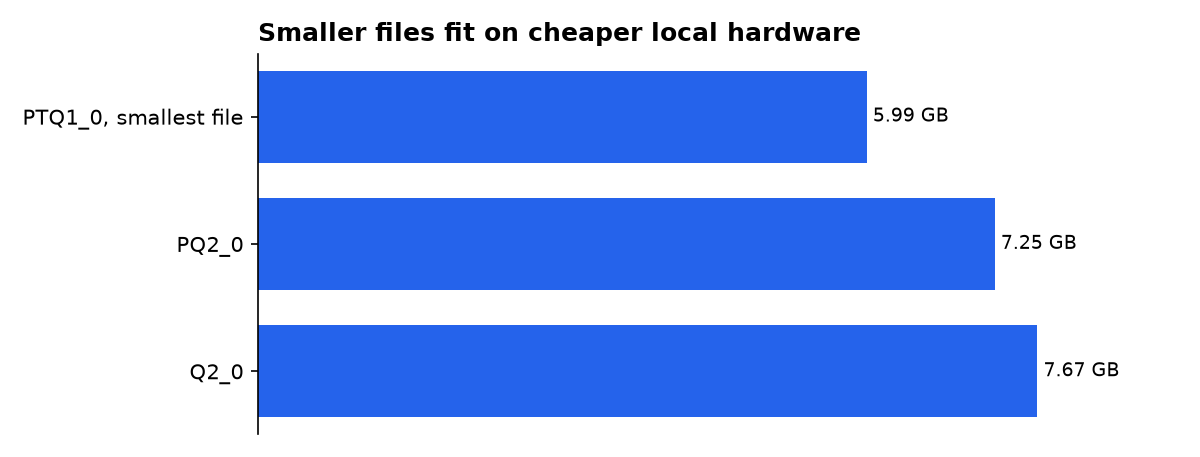
The table shows the decision in practical terms. PTQ1_0 minimises the download and estimated starting memory. PQ2_0 adds some space but follows the fork’s preferred path for several hardware backends. Q2_0 is slightly larger again, but it offers a simpler compatibility story.
Which Ternary Bonsai GGUF should you download?
Choose PTQ1_0 when minimum size is the main constraint. The file leaves the most room for the operating system, a small context and other local tools. The cost is a stronger dependence on PrismML’s runtime support.
Choose PQ2_0 when you are using the PrismML fork and want its recommended group-128 format. The fork describes PQ2_0 as preferred on Metal, CUDA, HIP and CPU. It also says this format is about six percent smaller than its group-64 alternative, although that comparison concerns the fork’s format choices rather than accuracy.
Choose Q2_0 when a broader llama.cpp route matters more than the smallest package. The PrismML fork describes its Q2_0 family as usable across the fork’s supported backends and says the newer naming is intended to work with mainline llama.cpp. Older repositories can use the same name for a legacy format, so users should check the model repository rather than assume that every Q2_0 file is identical.
Users who need images must reserve additional memory. The vision projector is not included in the main text-model figures. A text-only installation can therefore fit within a tighter budget than a multimodal installation using the projector.
- Need the smallest main file: start with PTQ1_0.
- Using Apple Metal, CUDA, HIP or CPU with the fork: start with PQ2_0.
- Want the least specialised file name: check Q2_0 first.
- Need image input: budget separately for the vision projector.
- Need speculative generation: check whether the selected variant includes the multi-token-prediction component.
What runtime support does the model need?
PrismML’s llama.cpp fork is the main software route for the release. The fork adds low-bit formats and runtime features on top of the llama.cpp project. It also warns users not to mix the fork’s libraries with a stock build.
That warning is important because model loading has several stages. The program must recognise the architecture, read the GGUF tensor types, allocate memory and run the corresponding matrix operations. A build can pass the first stage and still fail when it reaches an unsupported operation.
The fork supports CPU and several accelerator backends. Its documentation lists Metal for Apple silicon, CUDA for Nvidia hardware, HIP for AMD hardware and other backends. Support in the project does not guarantee equal performance on every chip, so users should treat backend labels as compatibility guidance rather than speed promises.
Apple users should also separate the model runtime from MLX. MLX is an array framework designed for Apple silicon, with CPU and GPU execution through a unified-memory model. PrismML maintains an MLX fork, but the supplied release information does not establish that every GGUF file can be loaded directly through MLX.
What did the latest runtime release change?
PrismML’s runtime release notes describe faster default prompt-processing kernels for Nvidia Hopper hardware. The reported gains are 28% for PTQ1_0 and 19% for PQ2_0, measured on an H200, with identical output reported by PrismML.
Those figures describe prompt processing, not every part of generation. Prompt processing reads and prepares the user’s input. Decoding produces the answer token by token. A faster prompt stage can improve time to first output without producing the same gain during a long response.
The same release adds a two-bit key-value cache option called pq2_0m. PrismML reports 22% to 44% less memory use than q4_0 for that cache type. Metal does not support it yet, so Apple users should not apply that saving to their own configuration.
A key-value cache stores attention state from earlier tokens. It helps the model continue a conversation without recomputing every earlier token, but it grows with context. This is why a model that fits at startup can still run out of memory during a long session.
Does two-bit compression make the model less accurate?
It can, but the available evidence does not measure the loss for this exact Bonsai-versus-AWQ comparison. Compression changes numerical values, and the effect depends on the base model, the packing method, the scale strategy, the runtime and the task.
A paper on low-precision LLM inference reports that four-bit accuracy depends on interactions between the numerical format, rotation, post-training quantisation and scale selection. The study covers other models and formats, so it cannot provide a Bonsai score. It does show why a bit-width label alone cannot predict the result.
Another study on measurement artifacts in quantized-model evaluations finds that evaluation choices can alter the apparent effect of compression. Its experiments report response-bias shifts, scoring differences and batch-related effects. Those findings make a controlled comparison more important, not less.
A credible Bonsai comparison would use the same prompts, generation settings, context lengths, runtime versions and hardware. It would report separate results for coding, reasoning, structured output, tool use, long context and image tasks. One overall score would hide the failures that matter most to a local deployment.
How should a local user make the choice?
Start with the memory limit. If the machine has less available memory than the selected file and its expected cache, the model will not be a comfortable local option. Leave headroom for the operating system and for the context used by the application.
Next, choose the runtime route. A user who values broad llama.cpp compatibility should begin with Q2_0. A user who accepts PrismML’s fork can choose PTQ1_0 or PQ2_0 based on file size and backend preference.
Then test the model on real work. Generic chat can conceal failures in formatting, arithmetic or tool invocation. A short local test set should include the prompts that the intended application will send.
- Check available RAM or VRAM before downloading.
- Reserve space for the context cache and any vision projector.
- Choose Q2_0 for the simpler compatibility route.
- Choose PTQ1_0 for the smallest main text-model file.
- Choose PQ2_0 when the PrismML fork’s backend guidance matches the hardware.
- Test structured output, coding, long prompts and tool calls.
- Keep the AWQ model as a quality baseline when the hardware can hold it.
Do not treat download size as a quality score. It answers one question: how much storage and starting memory the model needs. It does not answer whether the model is accurate enough for a particular job.
What we could not verify?
No public source in the public record provides a matched accuracy comparison between the Ternary Bonsai 2.5 GGUF variants and PrismML’s AWQ checkpoint. The material also does not isolate the effect of model differences from the effect of ternary packing.
The available runtime figures are vendor measurements. The prompt-processing improvements were measured on an H200, while the memory estimates come from arithmetic based on file sizes. Neither type of evidence predicts performance on a specific laptop, desktop GPU or Apple system.
The release material also does not establish that every claimed model capability works in every runtime. Text generation, image input, speculative generation and cache compression can depend on separate support layers. Users should verify each feature in the exact build they plan to deploy.
The most useful next evidence would be a reproducible, per-task comparison. It should hold prompts, sampling, context, hardware and runtime versions constant. Until that exists, the strongest case for Ternary Bonsai 2.5 is that it reduces the entry cost of local inference, not that it matches the larger checkpoint.
Sources
- PrismML — Ternary Bonsai 2.5 27B GGUF file list
- PrismML — Ternary Bonsai 27B AWQ 4-bit file list
- PrismML-Eng — llama.cpp fork
- PrismML-Eng — llama.cpp runtime release
- MXFP4 for LLM Inference: Complementary Post-Training Quantization Techniques and Their Interactions
- Measurement Artifacts in Trustworthiness Evaluations of Quantized Small Language Models

