

FuturPulse analysis · 24 November 2026
On 23 November 2026, Z.ai released GLM-5.4 as its first Loop Transformer, with 28 shared layers run twice at roughly the 750-billion-parameter scale. The model is available through the GLM Coding Plan, ZCode and Z.ai Chat. Public API access and downloadable weights have no announced release date.
At a glance
- GLM-5.4 uses input, cached-input and output multipliers of 4.6, 1.1 and 16 credits respectively.
- GLM-5.3 uses corresponding multipliers of 6.9, 1.7 and 24 credits in Z.ai’s Coding Plan.
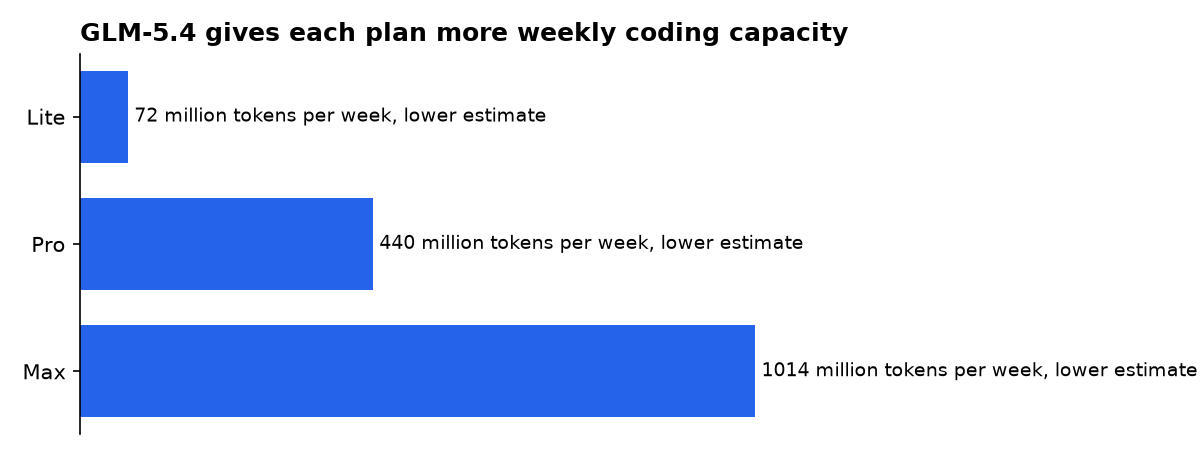
- At a 95% cache hit rate, Z.ai estimates GLM-5.4 Lite users can consume 72–146 million tokens weekly.
- The same plan estimates 48–97 million weekly tokens for GLM-5.3 at that cache rate.
- Z.ai has not published a benchmark table for the 750B-scale GLM-5.4 flagship itself.
What did Z.ai ship on 23 November?
Z.ai shipped GLM-5.4 to all GLM Coding Plan users, and also made it available in ZCode and Z.ai Chat. The company describes the model as part of “generalized coding”, where code supports software work, video, games, 3D scenes and CAD tasks.
The Next Web reports that API access will follow a safety evaluation. Z.ai also plans to release model weights after safety hardening, but it has not given dates for either step.
For a subscriber, GLM-5.4 is therefore a hosted coding-plan model rather than a generally priced public API model. Z.ai’s plan overview says every plan supports GLM-5.4, GLM-5.3 and GLM-5.3-Flash. It also says the plan starts at $18 per month, with Pro and Max tiers for heavier use.
The plan supports agent tools such as ZCode, Claude Code, Codex, OpenCode, AutoClaw and OpenClaw. Z.ai’s quick-start guide lists Claude Code, Roo Code, Kilo Code, Cline, OpenCode, OpenClaw, Crush, Goose and Cursor among supported tools.
That guide also separates Coding Plan keys from standard model API keys. The keys are not interchangeable, and the Coding Plan is restricted to officially supported tools and products. Teams expecting to place GLM-5.4 directly behind an existing production API should treat that as a current limitation.
How does the Loop Transformer change evaluation?
GLM-5.4 changes what a parameter count tells a buyer. A standard Transformer sends each token through each layer once. A Loop Transformer sends intermediate results through a shared block again, adding computation depth without adding another copy of those weights.
Z.ai says GLM-5.4 runs 28 layers of the GLM-5 base for two iterations at about the 750B-parameter scale. The company converted a pretrained base through continued training rather than training the looped design from scratch.
The underlying idea is older than GLM-5.4. The Universal Transformer paper, submitted on 10 July 2018, proposed a self-attentive recurrent model that combines Transformer-style parallel processing with repeated updates.
Looping does not make computation free. The same weights can be stored once, but the reused block still executes again. That creates a trade-off between memory, computation, response time and the quality of a completed task.
Z.ai describes three mechanisms intended to control that trade-off. Per-token gates regulate how much each pass changes the model’s internal state. A hybrid key-value cache reuses information from the first pass. Sparse-attention indices are also reused, avoiding a second selection step across the full context.
In plain terms, the model gets another internal pass over its work without storing a second full set of layers. That could help with long, multi-step tasks. It could also increase latency if the extra reasoning does not reduce retries.
What does the smaller-model evidence prove?
Z.ai’s strongest controlled evidence comes from a 30B-model ablation, not from the released flagship. The looped version used about 10% more training compute than a same-parameter baseline.
MarkTechPost’s reproduction of Z.ai’s reported table lists AIME25 rising from 19.17 to 30.42. GPQA-Diamond rose from 47.58 to 56.26, while AA-LCR rose from 40.33 to 47.67.
The same table reports smaller gains on MMLU-Pro and IFBench. MMLU-Pro rose from 71.65 to 75.05, while IFBench rose from 50.20 to 53.47.
Output length also fell on most tests. TestingCatalog reports that MMLU-Pro outputs became 14.9% shorter and GPQA-Diamond outputs became 11.7% shorter. AIME25 output length fell by 2%.
Those are results from a smaller test model. They do not establish the coding quality of the 750B-scale GLM-5.4 product. A model can improve on a controlled ablation and still behave differently at full scale.
Shorter answers also do not automatically mean faster engineering work. An agent can produce fewer visible tokens while spending more time on internal reasoning, tool calls or retries. Z.ai itself identifies “marathon thinking” loops as a weakness.
For coding teams, the useful test is task completion rather than output length. Measure whether the patch passes CI, how long it takes, how many retries it needs and how much manual review remains.
How much more work does the quota buy?
GLM-5.4 consumes fewer plan credits than GLM-5.3 under Z.ai’s published formula. Z.ai lists 4.6 credits for fresh input, 1.1 for cached input and 16 for output with GLM-5.4. GLM-5.3 uses 6.9, 1.7 and 24.
Cached input is context the service can reuse rather than process as new input. That matters for agents that repeatedly inspect the same repository files, test output and instructions.
The plan has two separate pools. Lite, Pro and Max receive 2,000, 12,000 and 28,000 five-hour credits. Their weekly pools are 10,000, 60,000 and 140,000 credits.
The five-hour allowance refreshes five hours after consumption. The weekly allowance resets every seven days. A larger weekly budget therefore helps sustained work, but does not prove that one long agent run can exceed its five-hour ceiling.
| Plan | GLM-5.4 weekly tokens | GLM-5.3 weekly tokens | What changes for a coding team |
|---|---|---|---|
| Lite | 72–146M | 48–97M | More room for routine fixes and codebase questions. |
| Pro | 440–870M | 290–580M | More headroom for several developers and repeated agent runs. |
| Max | 1,014–2,028M | 676–1,352M | More sustained capacity, not necessarily bigger short bursts. |
At a 95% cache hit rate, Z.ai’s table puts GLM-5.4 at 72–146 million tokens weekly on Lite, 440–870 million on Pro and 1,014–2,028 million on Max. The equivalent GLM-5.3 ranges are lower.
Peak hours run from Monday to Friday, 14:00–18:00 Singapore Standard Time, or UTC+8. The same weekly allowance can therefore cover very different workloads depending on when a team runs its agents.
How does GLM-5.4 compare with the alternatives?
The clearest comparison is between Z.ai’s subscription and public API alternatives. GLM-5.4 has no published per-token API price yet. OpenRouter lists prices, context windows and usage examples for OpenAI’s GPT-5.4 family, but those products do not share Z.ai’s five-hour credit system.
| Product | Price or plan cost | Five-hour cap | Context | Latency and tools |
|---|---|---|---|---|
| GLM-5.4 | GLM Coding Plan starts at $18/month | Lite 2,000 credits; Pro 12,000; Max 28,000 | 1M-token setting reported for supported coding tools | Up to 200 tokens/s off-peak; supported agent tools include Claude Code, Cline, Cursor and OpenCode |
| GLM-5.3 | Included in the GLM Coding Plan | Lite 2,000 credits; Pro 12,000; Max 28,000 | 1M-token context reported by Z.ai coverage | No comparable latency figure in the plan documentation; same supported-tool ecosystem |
| OpenAI GPT-5.4 | $2.50/M input; $15/M output | No Z.ai-style five-hour cap listed | 1,050,000 tokens | Latency and supported coding tools are not listed in the supplied model entry |
| OpenAI GPT-5.4 Mini | $0.75/M input; $4.50/M output | No Z.ai-style five-hour cap listed | 400,000 tokens | Latency and supported coding tools are not listed in the supplied model entry |
The comparison is not a universal quality ranking. It describes buying constraints. GLM-5.4 suits teams that want a fixed subscription, built-in agent integrations and a separate five-hour burst limit. GPT-5.4 suits teams that need a public API price and a documented 1,050,000-token context window.
OpenRouter’s usage examples show why output volume matters. For 1,000 agent steps using 30,000 input tokens and 2,000 output tokens per step, GPT-5.4 costs $105. GPT-5.4 Mini costs $31.50 for the same profile.
Those figures cannot be converted directly into GLM-5.4 dollars because Z.ai has not published a general API price. GLM instead deducts credits using input, cached-input and output multipliers, with tool calls charged separately.
Why are output tokens still the expensive part?
Output tokens are the most expensive category in both GLM-5.4 and GLM-5.3. GLM-5.4 charges 16 credits per 10,000-token unit, compared with 4.6 for fresh input and 1.1 for cached input.
A team that asks for long explanations, extensive logs or repeated full-file rewrites can therefore exhaust quota faster than its repository size suggests. Compact prompts and reusable context help, but they do not remove the five-hour cap.
The loop design could reduce visible reasoning or retries per accepted change. That remains a hypothesis for local testing, not a published flagship result.
- Use a small bug fix to measure basic patch quality.
- Use a multi-file refactor to measure retained context and retry count.
- Use a screenshot or design mock-up to test the vision capability.
- Record elapsed time, accepted patch rate and credits consumed.
What can the supported tools do?
The Coding Plan is more than a model-access subscription. Z.ai’s documentation lists conversational programming, code debugging and code optimisation as supported workflows.
The same documentation describes a Vision MCP Server for analysing UI mock-ups, flowcharts, architecture diagrams and screenshots. It also lists Web Search MCP, Web Reader MCP and Zread for technical research and structured webpage extraction.
Those tools change the practical comparison with a bare API model. A developer can give an agent an image, ask it to inspect documentation and then request a code change in one supported environment.
The tools also create another cost category. Z.ai charges Web Search, Web Reader and Zread calls at 1.2 credits per call. A long workflow can therefore consume credits through tools even when its model output is short.
Does GLM-5.4 already prove better coding?
No. GLM-5.4 has a plausible architectural case and a smaller-model ablation, but Z.ai has not published a flagship coding benchmark table with task definitions, settings, scores and reproducible results.
WinBuzzer reported an early KingBench 4 test in which GLM-5.4 placed seventh among 19 models and received 55.3% of the available points. The report also says the suite took 431 minutes.
That result is a secondary account of one run. It does not provide a directly linked leaderboard record, complete task setup or reproducible evaluation package. It should not be treated as a verified flagship benchmark.
Managers should therefore separate two decisions. GLM-5.4 is available now for teams that value image-aware coding, long context and subscription quotas. Its claim to beat named alternatives on everyday coding remains unproven.
What was promised versus what shipped?
The release is clearest when separated into current access and future commitments. The plan, supported tools, credit rules and model availability are usable today.
| Date | Promise or claim | What is demonstrably available |
|---|---|---|
| 10 July 2018 | The Universal Transformer paper proposed recurrent layer reuse. | The research established a predecessor concept, not GLM-5.4. |
| 23 November 2026 | Z.ai announced GLM-5.4 as its first Loop Transformer, with 28 shared layers run twice. | GLM-5.4 became available through the GLM Coding Plan, ZCode and Z.ai Chat. |
| 23 November 2026 | Z.ai positioned the model against 2T–3T-parameter systems. | No public flagship benchmark table explains that comparison. |
| 24 November 2026 | Z.ai’s plan documentation lists credit multipliers and token allowances. | The documentation provides five-hour caps, weekly pools and cache-based ranges. |
What we could not verify?
Z.ai has not published a dated general API launch, a release date for downloadable GLM-5.4 weights or a full benchmark table for the 750B-scale model. The company has also not published a general per-token API price for GLM-5.4.
The reported KingBench 4 result remains incomplete. WinBuzzer’s account reports seventh place, 55.3% and 431 minutes, but does not provide a directly linked leaderboard run, full task setup or reproducible result package.
The exact effect of the loop architecture on merge rates, review effort and latency also remains unknown. Developers can test it by running GLM-5.4 and their current model against the same repository, tests and time budget.
The next useful evidence would be a public flagship evaluation with task definitions, model settings, latency, credit or token use and scores for named alternatives. Until then, the most defensible reason to trial GLM-5.4 is its access model and tool support, not an unverified leaderboard claim.
Sources
- Z.ai — GLM-5.4: Toward generalized coding with our first loop transformer
- Z.ai Developer Documentation — GLM Coding Plan overview
- Z.ai Developer Documentation — GLM Coding Plan quick start
- arXiv — Universal Transformers
- OpenRouter — model prices and context windows
- The Next Web — GLM-5.4 launch and architecture
- MarkTechPost — GLM-5.4 architecture and reported ablation scores
- TestingCatalog — GLM-5.4 release coverage
- WinBuzzer — GLM-5.4 image input and early KingBench result

