

Jevgrep is not one tool: as of 30 September 2026, dzhng/jevgrep is at version 0.6.0 with a jg agent skill, while nassim-arifette/jevgrep offers a separate MCP server and requires Node.js 24.
At a glance
- dzhng/jevgrep uses natural-language questions to return files, source excerpts and line references through the
jgcommand. - The dzhng project’s version 0.6.0 was released on 29 September 2026, according to GitNova’s repository tracker.
- nassim-arifette/jevgrep can expose one MCP tool,
semantic_search_code, after a repository is explicitly authorized. - The dzhng benchmark reports 8 of 10 solves for both its Jevgrep setup and baseline, while its Sol-only task cost fell from $7.62 to $5.44.
Which Jevgrep should coding teams install?
The practical answer is dzhng/jevgrep if your main goal is to teach Claude Code, Codex or OpenCode when to search before editing. Its command is jg, its package is @dzhng/jevgrep, and its built-in jg skill installer places operating instructions where supported coding agents can use them. The project requires Node.js 22 or later, plus macOS or Linux. The project README specifies those requirements and the skill workflow.
nassim-arifette/jevgrep is a different package despite the almost identical name. It installs as @nassim-arifette/jevgrep, keeps the command name jevgrep, requires Node.js 24, and is designed around repository authorization, inspection and an optional local Model Context Protocol server. Its README explicitly warns that the unscoped jevgrep package belongs to another project.
This naming collision is the first buying decision, not a packaging footnote. Search listings for the smaller project describe CLI and MCP access with exact excerpts, while the larger project’s current pitch is agent-oriented retrieval plus a skill installer. JevHunt describes the nassim-arifette project as CLI-or-MCP semantic search; GitNova lists the dzhng project at 1,868 stars and version 0.6.0 on 30 September 2026.
How does semantic code search differ from grep?
Semantic search means asking for behaviour rather than a known string. Instead of searching for invalidateCache, an agent can ask where cache invalidation happens after an account change. Jevgrep uses Jev to assess relevance, then returns evidence for the agent to read rather than a prose answer that might blur code, configuration and tests. The dzhng README says jg judges relevance across folders, files and declarations.
That matters before an agent edits unfamiliar code. The useful output is not “the answer”; it is a compact map of likely files, selected snippets and line locations. The agent still needs to inspect surrounding code, make the change, and run tests. The project says its output is evidence, not a guarantee that every relevant file was found.
Exact search remains the better first move when the identifier, path or error text is known. Both implementations say conventional text search such as rg is usually faster in that case. Jevgrep earns its extra network call when the question spans parts of a repository that do not share words. The nassim-arifette README positions its tool as a complement to exact search, not a replacement.
What does the CLI feed to an agent?
dzhng/jevgrep starts with one standard-output response. It presents a summary and compact file list, then selected source with line references, followed by declaration and call locations. It parses declarations for Python, TypeScript or JavaScript, Go and Rust; other text receives a fallback treatment. The repository documents that output order and language coverage.
The product’s distinctive feature is not a permanent local vector index. It explores the repository hierarchy, uses previews to select files, then follows qualifying branches to source units and nearby context. That approach is useful for a new checkout because there is no separate embedding build step described in the public README. Nicheloom characterises the project as a CLI that calls an external Jev service to discover files and feed context to coding agents.
The smaller JevGrep takes a more cautious route. Its inspect command stays offline and shows eligible files, fragments, exclusions and expected work before search; doctor also avoids a network request. A real search remotely evaluates eligible fragments with the selected provider. The nassim-arifette README describes those offline inspection steps and the remote evaluation path.
# dzhng/jevgrep: install both the command and agent instructions
npm install -g @dzhng/jevgrep
jg auth
jg skill
jg "Where is authentication checked before a request reaches a handler" .

# nassim-arifette/jevgrep: inspect a repository before enabling evaluation
npm install -g @nassim-arifette/jevgrep
jevgrep init --global
jevgrep init
jevgrep inspect
Can Jevgrep work with Claude Code and Codex?
Yes, but the two projects integrate differently. dzhng/jevgrep’s jg skill detects Claude Code, Codex, OpenCode and other agents, then installs instructions explaining when to invoke the command and how to interpret its context. The command itself does not configure provider credentials, so setup still includes jg auth. The project says the skill installer is required for agent setup and separate from authentication.
nassim-arifette/jevgrep exposes a stdio MCP server with one tool named semantic_search_code. Its documented Codex configuration uses a 360-second tool timeout, leaving margin over the tool’s 300-second default search deadline. That is a useful integration detail for teams whose agent client expects tools rather than shell instructions. The MCP setup guide provides the Claude Code and Codex configuration examples.
Neither route means an agent should search before every edit. A good policy is simpler: use direct file reads and rg for known locations, then invoke semantic search for an unfamiliar cross-cutting behaviour. That keeps tool use focused on the actual problem described by an engineering essay: teams can generate code quickly while losing the architectural knowledge needed to maintain it. Simon Späti argues that intent, design and maintainability remain the harder problem than code generation.
What leaves the developer’s computer?
Source handling is the central risk, because Jevgrep is not offline semantic search. dzhng/jevgrep sends eligible source content to Jev through the provider selected during authentication. It excludes hidden files, dependencies, build output, binaries and obvious credentials by default, but the maintainer says those filters are not a guarantee that sensitive content is absent. The dzhng privacy section recommends choosing a search root that you intend to send.
nassim-arifette/jevgrep is more explicit about the payload. It says a search sends eligible source fragments, the question, repository-relative paths, line ranges and the relevance criterion. It also excludes common credential files, .env files, dependencies, generated output and minified files, while warning that automated filters cannot catch every secret. Its security guidance recommends reviewing inspect output and adding project exclusions in .jevgrepignore.
For a public repository, this may be an acceptable retrieval trade. For proprietary code, set a narrow root, exclude generated data and secret-bearing paths, inspect the scope, and seek security approval for the selected provider’s retention terms. The provider choice is not cosmetic: dzhng/jevgrep supports Vercel AI Gateway, TypeSafe, OpenRouter, OpenCode Zen and compatible endpoints. The project lists those provider choices in its installation requirements.
Which option is worth the cost?
There is no verified public per-search price for Jev itself in either Jevgrep README, so a team cannot calculate a monthly bill from repository size alone. dzhng/jevgrep does publish one limited task comparison: both setups solved 8 of 10 tuned Python SWE-bench tasks, while Sol-only cost declined from $7.62 to $5.44. That is a project-reported result, not a universal saving claim. The benchmark description says it excludes Jev cost in the older comparison and does not measure speed.
| Option | Exact figure or limit | What the buyer gets | Evidence tier | Decision |
|---|---|---|---|---|
dzhng/jevgrep with jg skill | Version 0.6.0, released 29 September 2026 | CLI retrieval plus agent instructions for Claude Code, Codex and OpenCode. | Primary project docs; release date from tracker | Best fit for an agent-first workflow. |
| nassim-arifette/jevgrep with MCP | Node.js 24 and a 300-second default search deadline | Repository authorization, offline inspection and one MCP search tool. | Primary project documentation | Best fit where preflight inspection matters. |
| dzhng Jevgrep benchmark setup | $5.44 Sol-only cost across 10 tasks | Same 8 of 10 reported solves as its baseline in one frozen evaluation. | Project-reported benchmark | Use as a pilot hypothesis, not a purchasing forecast. |
| Baseline agent setup in that evaluation | $7.62 Sol-only cost across 10 tasks | No Jevgrep retrieval in the compared setup. | Project-reported benchmark | Keep as the control group for your own trial. |
| OpenRouter-backed route | No Jev public per-search price verified | A supported provider path, but final spending depends on provider and request volume. | Terms and Jev-specific cost not publicly verified | Do not budget from general model prices alone. |
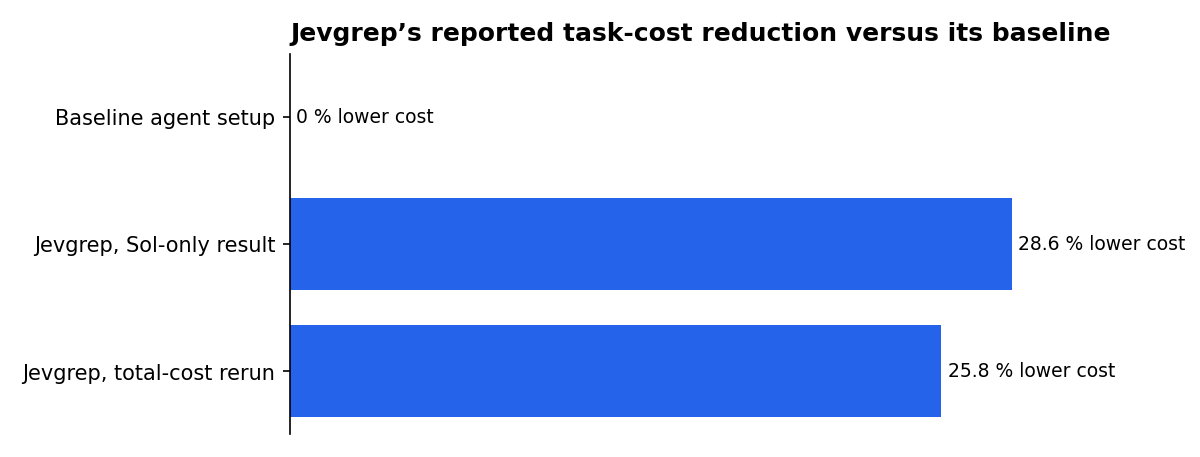
The later rerun is more cautious. dzhng/jevgrep reports a 25.8% lower total cost when Jev was included, still with 8 of 10 tasks solved; its subsequent 0.5.0 evaluation retained those 8 solves but says combined Sol-plus-Jev cost was 2% to 3% higher. Those figures show why buyers should test their own repositories rather than treating “30% lower cost” as a rate card. The project records the changed accounting basis and the 0.5.0 trade-off.
How should a team trial Jevgrep?
Run a small controlled trial before making it part of every coding-agent prompt. Pick five maintenance tasks where engineers know the expected files, but the agent does not. Track whether the search found useful starting points, whether it missed sensitive paths, and whether total model spending fell after including the retrieval call.
- Choose dzhng/jevgrep when agent instruction installation is your main requirement.
- Choose nassim-arifette/jevgrep when you need explicit authorization, offline inspection and an MCP endpoint.
- Keep
rgas the default for a known function name, error message or path. - Block semantic searches in repositories where sending source excerpts to a hosted provider is unacceptable.
- Measure total task cost, including the search provider, not only the coding model’s bill.
The reader should actually do this: install one implementation in a non-sensitive repository, set a narrow search root, and compare it with a no-search control on real maintenance work. For most coding-agent users, dzhng/jevgrep is the clearer first trial because its skill teaches the agent when to call the CLI. For controlled environments, nassim-arifette/jevgrep’s inspection-first MCP design is the safer starting point. DecisionEval also identifies the nassim-arifette tool as a hosted decision-API client rather than a local-weight search engine.
What we could not verify?
No public Jevgrep material establishes a universal search quality score, a guaranteed latency, or a fixed Jev price per repository search. The reported 8-of-10 benchmark is a narrow evaluation, and neither implementation proves that semantic retrieval improves every language, codebase or agent model. A reproducible third-party benchmark could settle comparative quality and total cost.
Real-world MCP behaviour with Codex and Claude Code also remains partly unqualified for nassim-arifette/jevgrep, whose README asks users to confirm that the client exposes semantic_search_code and completes a search. Provider operators could settle payload retention, model-version stability and regional processing terms with public contractual documentation. The project labels its live-client integration examples as needing confirmation.
Sources
- PRIMARY SOURCE — dzhng/jevgrep repository
- PRIMARY SOURCE — nassim-arifette/jevgrep repository
- GitNova project tracker for dzhng/jevgrep
- JevHunt listing for nassim-arifette/jevgrep
- Nicheloom listing for jevgrep
- Simon Späti on architecture and AI-generated code
- OpenRouter model directory
- DecisionEval profile for nassim-arifette/jevgrep

